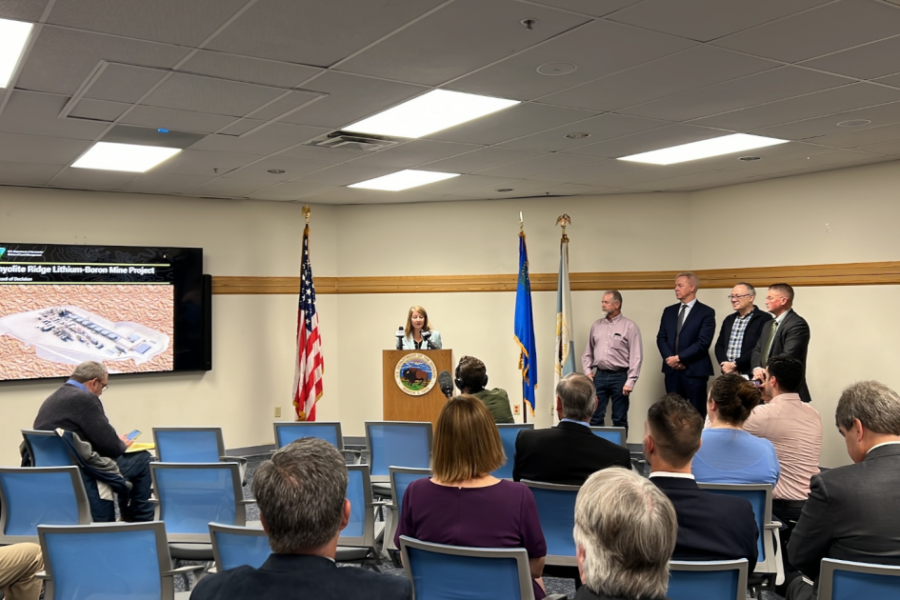
The Bureau of Land Management approved the Record of Decision for the Rhyolite Ridge Lithium-Boron Mine on October 24, 2024, clearing the final step in the NEPA review process for the project in southern Nevada’s Silver Peak Range. The project proponent is Ioneer, whose CEO is Bernard Rowe. BLM approved the preferred alternative outlined in the final Environmental Impact Statement, which was released in September 2024 and developed in collaboration with the U.S. Fish and Wildlife Service. The announcement was made in Reno, Nevada, and attended by Acting Deputy Secretary of the Interior Laura Daniel-Davis and BLM Nevada State Director Jon Raby, among others.
What it means
The Record of Decision authorizes Ioneer to proceed with a mine that BLM said could supply lithium for approximately 370,000 electric vehicles annually once operational. The project will also produce boron. During construction, the mine would employ up to 500 workers; during operations, approximately 350 workers. BLM estimated the mine would generate roughly $125 million in wages annually over the life of the project. Acting Deputy Secretary Laura Daniel-Davis said the project “is essential to advancing the clean energy transition and powering the economy of the future” and that it demonstrates responsible critical mineral development can proceed while protecting public lands. BLM Director Tracy Stone-Manning said the decision reflects the agency’s goal of “supplying lithium that will power our clean energy future” while safeguarding public lands, and described it as supporting the Biden-Harris administration’s climate goals.
The approval includes conditions to protect the Tiehm’s buckwheat, a plant listed as endangered or threatened whose only known populations and critical habitat fall within the project area. Ioneer modified its project proposal to limit impacts on the species, and the approval requires redesigning and relocating project features, funding Tiehm’s buckwheat propagation work, and developing a formal protection plan for the plant. BLM consulted with nine Tribes during the review process, including the Benton Paiute, Big Pine Paiute, Bishop Paiute, Duckwater Shoshone, Ely Shoshone, Shoshone-Paiute of the Duck Valley Indian Reservation, Te-Moak Tribe of Western Shoshone, Timbisha Shoshone, and Yomba Shoshone.
Key facts
- Project: Rhyolite Ridge Lithium-Boron Mine, southern Nevada’s Silver Peak Range
- Proponent: Ioneer (CEO Bernard Rowe)
- Approving agency: Bureau of Land Management, U.S. Department of the Interior
- Record of Decision date: October 24, 2024
- Final EIS released: September 2024, developed with U.S. Fish and Wildlife Service
- Projected lithium supply: ~370,000 electric vehicles annually (according to BLM)
- Construction workforce: up to 500 workers; operations workforce: ~350 workers
- Estimated annual wages over mine life: $125 million
- Tribes consulted: 9, including Benton Paiute, Big Pine Paiute, Bishop Paiute, Duckwater Shoshone, Ely Shoshone, Duck Valley Shoshone-Paiute, Te-Moak Western Shoshone, Timbisha Shoshone, Yomba Shoshone
- Species protections required: Tiehm’s buckwheat propagation funding, project redesign, formal protection plan
Source: Bureau of Land Management news release (blm.gov)